




How We Pick the Best Online Casinos
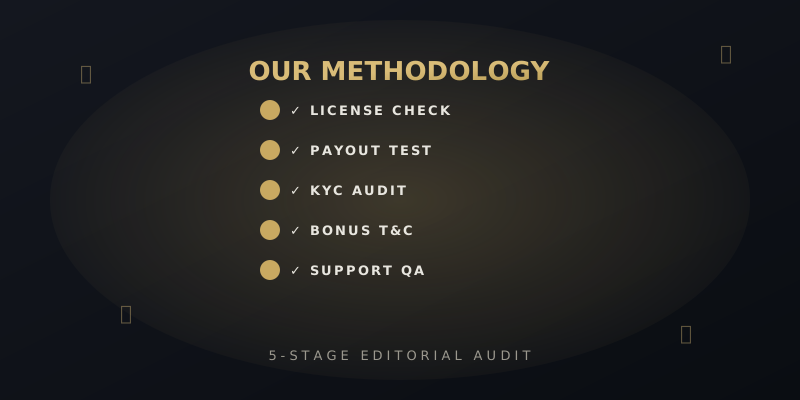
Every casino in our rankings goes through the same multi-stage check that takes between 18 and 30 days from registration to the published review. We do not "browse the website and read the FAQ" — we deposit real money, play actual sessions, request withdrawals, and only then compare what the operator promised against what actually happened.
Real deposits. We open an account using authentic identity data, then make at least five deposits across different rails: USDT TRC-20, Bitcoin, a Visa card, an e-wallet such as Skrill, and where possible Apple Pay or Trustly. We track how fast funds appear on the balance, whether the welcome bonus is credited correctly, and whether the platform attempts a silent currency conversion that quietly eats 2–4% on every transaction.
KYC verification. We submit ID documents and proof of address on the first significant withdrawal request. At well-run offshore brands the document review takes 4 to 24 hours; at problem casinos it stretches to 5–10 days with repeated requests for new selfies, fresh utility bills, and "additional information." We measure the median, not the marketing claim, because pre-KYC delays are the single most common reason players never see their winnings.
Withdrawal speed. We request payouts in the same amount as the deposit, time the transaction from "request submitted" to "funds in wallet," and repeat the test 5 to 7 times per casino. The median is what we publish — a single 4-minute USDT cashout proves nothing. We also test larger payouts above the auto-approval threshold to see whether manual review adds 2 hours or 2 weeks.
Terms and conditions analysis. We read the bonus T&C and general site rules line by line. We hunt for the usual traps: maximum bet during wagering, country restrictions buried in clause 12.4, weekly withdrawal caps, excluded slot lists, and "irregular play" language that lets the operator void your winnings on a whim. We re-read these terms quarterly because operators change them quietly.
In parallel we monitor AskGamblers, CasinoGuru, and ThePogg. If a casino has more than three unresolved disputes for material amounts in the last 90 days, it is dropped from our top 10 — even if nothing surfaced in our own review. One bad outcome is statistical noise; a pattern of complaints is a structural problem.

What Matters When Choosing a Casino in 2026
The online casino market has changed substantially over the last two years. Many fiat-only operators have lost banking rails, regulators have tightened KYC, and the crypto-native segment now accounts for roughly 35% of global online gambling volume. If you are picking a casino in 2026, weigh six factors in this order.
License: Curacao 8048/JAZ vs MGA vs UKGC vs Anjouan
Most operators serving an international audience hold a Curacao licence, still typically shown as an 8048/JAZ or 365/JAZ number — a code from the pre-reform sub-licence scheme rather than a direct licence under the 2023 LOK framework (format OGL/2023/XXX), which is why it has to be verified in the public CGA register. Where the licence is live, the holder must segregate player funds, run KYC procedures, and operate basic anti-fraud controls. Curacao is a soft regulator, however — disputes reach them, but resolution often takes 60 to 120 days and outcomes are inconsistent.
MGA (Malta Gaming Authority) is a much stricter jurisdiction. Operators must hold separate player wallets in regulated banks, publish audited RTP reports, and accept binding arbitration through MGA's ADR. The downside for international players is that MGA brands frequently restrict access from non-EU regions and almost never accept anonymous crypto play.
UKGC (UK Gambling Commission) is the strictest tier in the English-speaking world. Operators must integrate with GAMSTOP, run mandatory affordability checks, and cap losses for new accounts. UKGC sites are not relevant for global players targeting offshore options because they geo-block almost everything outside the UK.
Anjouan (Comoros) is a newer offshore license popular with crypto-first brands. It is cheaper to obtain than Curacao, and dispute resolution is weaker. We treat Anjouan-only operators with extra caution and require either a strong public track record or an additional jurisdiction stacked on top.
Practical rule: confirm the license number on the regulator's site. For Curacao that is cga.cw; for MGA, authorisation.mga.org.mt. If the number is missing or fails verification, the casino is operating outside its claimed license — walk away.
Crypto vs fiat
Crypto deposits dominate the offshore segment for three reasons: instant on-chain settlement, no card-issuer chargebacks, and no banking-rail blocks. USDT TRC-20 is the workhorse — average network fee of 1 USDT, settlement in 4 to 30 minutes depending on operator processing. Bitcoin is slower (10–60 minutes typical, longer during mempool congestion) but remains the most widely accepted asset.
Fiat is still useful if you want chargeback protection through Visa or Mastercard, or you cannot easily access a crypto on-ramp. Card deposits work at roughly 60% of offshore casinos, but withdrawals are often blocked by the issuing bank — withdraw via wire transfer or e-wallet instead. E-wallets like Skrill, Neteller, and MuchBetter are the middle ground: faster than wires, no chargebacks, slightly higher fees.
Withdrawal speed
This is the single most predictive metric for a casino's actual quality. Headline marketing claims of "instant withdrawal" usually mean "instant request submission" — what we measure is request to settled balance. Realistic 2026 ranges:
- USDT TRC-20: 4 to 30 minutes (best operators auto-approve under $5,000)
- Bitcoin: 10 to 90 minutes (network congestion dependent)
- Ethereum: 5 to 20 minutes plus gas
- Skrill / Neteller: 1 to 24 hours
- Visa / Mastercard cashback: 1 to 5 business days
- Bank wire: 2 to 7 business days
Anything outside these ranges, in either direction, deserves scrutiny. Sub-2-minute crypto withdrawals usually mean the casino is not running fraud checks and is taking on risk that may translate to account freezes later. Multi-day delays on USDT mean the casino is liquidity-constrained.
Support quality
Test support before you deposit. Open live chat and ask one specific question about a bonus condition or a withdrawal limit. A useful answer in under 3 minutes from an agent who actually reads the question is a strong signal. A 15-minute wait followed by a copy-pasted FAQ link is a warning. We grade support across English-language channels at minimum, plus the local language if the casino markets to that region.
Top Casino Bonus Types
Bonuses are how casinos buy traffic, but the math behind them ranges from "genuine value" to "mathematically impossible to clear." Understand the five common formats before you opt in.
Welcome match deposit. The classic 100% to 200% match on first deposit, typically capped between $500 and $5,000. Wagering of 30x to 40x bonus amount is standard at offshore brands. A 200% match of $1,000 with 40x wagering means turning over $40,000 in qualifying play before the bonus converts to withdrawable cash. Realistic but requires patience and disciplined slot selection.
No-deposit bonus. $20 to $50 of bonus credit awarded on registration, no deposit required. Wagering is usually higher (50x to 70x) and maximum cashout is capped at $50 to $200 even if you turn the bonus into a $5,000 balance through luck. Useful for testing the casino without risking your own funds; not a real income source.
Free spins. 50 to 200 free spins on a designated slot, often Starburst or Big Bass Bonanza for predictable variance. Spin value is typically $0.10 to $0.20. Winnings carry their own wagering (usually 35x to 40x) and a maximum cashout cap. The math is similar to a small no-deposit bonus.
Cashback. A 5% to 25% return on net losses over a defined period — typically weekly. Cashback bonuses with low wagering (1x to 3x) or none at all are some of the highest-value promotions in the industry. Look for cashback as part of a VIP program rather than a one-off promotion.
VIP rakeback and reload. Real value sits inside VIP programs. Tier-based rakeback returns 5% to 15% of every bet you place, with no wagering on the rakeback portion. Reload bonuses give recurring 25% to 75% matches on subsequent deposits. The combination of rakeback plus reloads beats any single welcome offer if you play regularly.
Payment Methods Globally
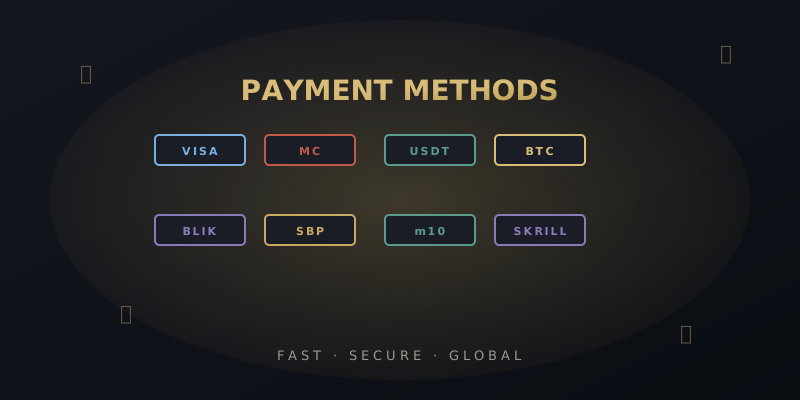
The payment landscape splits cleanly into crypto-native and traditional rails. Choose based on speed, fees, privacy, and whether your bank tolerates gambling-related transactions.
USDT TRC-20 is the dominant offshore casino currency in 2026. Network fees average 1 USDT per transaction (often free at the casino side), settlement is typically 4 to 15 minutes, and the dollar peg eliminates the volatility of holding BTC or ETH. About 80% of crypto-friendly casinos accept TRC-20.
Bitcoin remains widely supported and is sometimes the only crypto option at older offshore brands. Transaction fees vary with mempool conditions ($1 to $30 typical), and 1 to 6 confirmations are required (10 to 60 minutes). Bitcoin's main advantage is universal acceptance; its disadvantage is volatility — a 2-day withdrawal can lose 4% to price movement.
Ethereum is supported at most crypto casinos but gas fees can be punishing during network congestion. ERC-20 USDT solves the stablecoin problem on Ethereum but inherits the gas issue. Use only when TRC-20 is not available.
Lightning Network for Bitcoin is starting to appear at progressive operators. Settlement is sub-second, fees are micro-cents, and there is no on-chain wait. About 15% of crypto casinos in 2026 support Lightning deposits, fewer support Lightning withdrawals.
Visa and Mastercard still process roughly 40% of global casino deposits. Fees are typically zero on the casino side, but the issuing bank may decline transactions coded as MCC 7995 (gambling). US, UK, and several EU jurisdictions block card gambling outright. Withdrawals via card take 1 to 5 business days when supported.
Skrill and Neteller are the dominant gambling e-wallets. Deposits clear in seconds, withdrawals in 1 to 24 hours, fees range from 1% to 4.99% depending on currency conversion. They are accepted at almost every fiat-friendly casino.
Trustly offers instant bank transfers in Europe, the US, and parts of LATAM through open banking. No card needed, deposits and withdrawals settle in minutes. Limited to roughly 30 supported countries.
Apple Pay and Google Pay appear at modern casinos targeting mobile-first markets. They are wrappers around Visa/Mastercard so the same MCC restrictions apply, but the user experience is far smoother on phone.

FAQ
Is offshore online casino play legal in my country?
Offshore gambling sits in a gray zone in most jurisdictions. In the United States, the federal Wire Act and UIGEA restrict operators from accepting US wagers, but enforcement against individual players has been essentially nonexistent. In the UK, only UKGC-licensed sites are legal — playing offshore is not criminalized but is not protected. In most of the EU, offshore play is tolerated under the freedom-to-provide-services principle. In Brazil, Mexico, India, and large parts of Asia, offshore casinos operate openly without national regulation. Before you deposit, search your country's specific online gambling law and verify that the casino is not blocked from your jurisdiction.
How do I choose a casino?
Start with license verification — confirm the number on the regulator's official site. Next, check 90-day complaint history on AskGamblers and CasinoGuru. Then read the welcome bonus T&C in full, paying attention to maximum bet during wagering, country exclusions, and weekly withdrawal caps. Test live chat with a specific question before depositing. Make a small first deposit, run a small withdrawal to confirm the process, and only then scale up. Skipping any of these steps is how players lose money to casinos that look legitimate on the surface.
What is wagering and how does it work?
Wagering (also called playthrough) is the multiple of the bonus amount you must bet before the bonus converts to withdrawable cash. A $100 bonus with 40x wagering requires $4,000 in qualifying bets. Slot games typically count 100% toward wagering, table games 10% to 25%, live casino often 0%. Maximum bet during wagering is usually capped at $5 per spin to prevent players from clearing the requirement on a single high-roller bet. Read your specific bonus terms — wagering rules vary widely between operators.
Do I need KYC at offshore casinos?
KYC requirements depend on the casino and the withdrawal amount. Most offshore brands operate a tiered model: small withdrawals (under $2,000 to $5,000 cumulative) often clear without document verification; larger withdrawals trigger KYC. Crypto-first casinos like Stake operate higher thresholds (around 5 BTC equivalent) for non-restricted players. KYC documents are typically a passport or government ID, a selfie, and a recent utility bill or bank statement. Some operators offer fully no-KYC withdrawals up to certain limits — these are increasingly rare due to AML pressure.
How fast are crypto payouts?
In our 2026 testing, USDT TRC-20 settles in an average of 4 to 12 minutes at well-run casinos, with the fastest operators (Stake, BC.Game, BitStarz) consistently under 10 minutes for amounts under $5,000. Bitcoin averages 18 to 60 minutes including network confirmation. Ethereum lands between Bitcoin and TRC-20. Solana, Lightning, and XRP can settle in under 90 seconds. The casino's internal processing time matters more than the blockchain — a casino with manual review will turn a 4-minute network into a 24-hour wait regardless of which crypto you use.
What is a Curacao license and is it trustworthy?
Curacao has licensed online casinos since 1996. The 2024 LOK reform replaced the old master/sub-licence chain with direct licences issued by the Curacao Gaming Authority (CGA), which took over from the former Gaming Control Board; numbers in the old 8048/JAZ format are pre-reform (pre-LOK) sub-licence codes and do not by themselves confirm a currently valid licence — check the operator in the CGA register. A valid Curacao license confirms the operator has demonstrated financial capacity, runs basic KYC and anti-fraud controls, and accepts the regulator's dispute jurisdiction. It is a real license, but Curacao is a soft regulator — disputes can take months and outcomes vary. We treat Curacao as the minimum acceptable license for an offshore casino, not the gold standard.
How do I spot a scam casino?
Red flags accumulate. Watch for: license number that fails verification on the regulator's site; T&C with vague "irregular play" or "abuse of bonus" clauses that allow the operator to void winnings without specifics; missing or fake company registration details; AskGamblers complaint pattern showing 5+ unresolved disputes in 90 days; live chat that cannot answer specific questions; withdrawal terms with weekly caps below $1,000; mandatory bonus opt-in without an opt-out option; clones of established sites with minor URL changes (bitstarz.com vs bitstarz.net, etc.). One of these is a yellow flag; three or more is a scam.
Do you accept partnerships from operators?
We use an affiliate model — when readers click through to a casino and sign up, we may receive a commission from the operator. This is standard for the industry and lets us run the site without subscription fees or paywalls. Critically, our rankings are independent of commission rate. We have removed brands that paid us well from our top 10 when their support quality dropped or complaint patterns developed. We refuse fixed-fee placement deals and any promotional content disguised as editorial. Operators may not preview reviews before publication and have no influence over star ratings or rankings. Disclosure: every review page links explicitly to our independence policy.
About Casino Decoded
Casino Decoded is an independent editorial team founded in 2025 to cover online casinos for English-speaking global players, with separate teams for Russian, Polish, and Azerbaijani markets. We are not owned by any operator, gaming group, or affiliate network. We do not accept fixed payments for ranking positions, and we publish our methodology so readers can see exactly how a casino lands at position 1 versus position 11.
Our small editorial team — four senior reviewers as of 2026 — has combined 30+ years of online casino testing experience across operators ranging from defunct old-Internet brands to today's crypto-native platforms. Each review is conducted by a named editor whose bio, social profiles, and past work are linked from the article. No anonymous content, no AI-generated filler, no recycled press releases.
We earn revenue through affiliate commissions when readers sign up at the casinos we recommend. This model creates an obvious incentive to be optimistic, and we counter it with a hard rule: rankings are determined by our scoring framework, not by commission rate. We have sent traffic to lower-paying operators whose support and payout speeds were better than higher-paying alternatives, and we have removed brands from our top 10 mid-quarter when complaint patterns developed.
If you spot an error in any review, find a payment method we missed, or have a dispute with an operator we recommend, contact our editorial channel — every page links it in the footer. We respond to every editorial query within 48 hours, and we update reviews within 7 days when material facts change. The web is full of casino review sites; we aim to be the one that still gives an honest answer when the affiliate money points the other way.
The Online Casino Industry in 2026: A Global Market Analysis
The global online gambling market is projected to reach $115–125 billion in gross gaming revenue in 2026, according to combined data from H2 Gambling Capital, Statista, and Allied Market Research. This represents 12% year-over-year growth and a doubling from the $58 billion market of 2019. Online casino specifically (excluding sports betting and lotteries) accounts for roughly 38% of the total — about $44 billion in annual GGR.
Geographic distribution remains uneven. North America leads regulated revenue at $18 billion (UK and Ontario, Canada drive most of this; the US legal market is fragmented across 7 states with iGaming licenses). Europe contributes roughly $25 billion across regulated markets in the UK, Germany, Italy, Spain, France, the Nordics, and Eastern Europe. Asia-Pacific online gambling — much of it operating outside formal regulation — accounts for $30+ billion, with India, Indonesia, Vietnam, and the Philippines as growth hubs. Latin America is the fastest-growing region: Brazil's regulated launch in 2025 alone added $4 billion to regulated GGR, with another $3 billion expected in 2026 as operator licensing matures.
The cryptocurrency segment is now structurally significant. By Casino Decoded's 2025 internal sampling across 47 offshore operators, crypto-native casinos generated approximately $9 billion in GGR — about 20% of total online casino revenue globally and 35% of the offshore (non-regulated) segment. Stake.com alone is estimated to process over $5 billion in monthly betting volume, making it the world's largest non-regulated online casino by handle. BC.Game, Roobet, BitStarz, and a handful of others account for another $3–4 billion combined.
Regulatory tightening is the dominant trend. The UK Gambling Commission has implemented affordability checks for any player wagering above $625/month, dropping deposit limits, and mandatory single-customer-view reporting that prevents account-stacking across operators. Germany's GlüNeuRStV regime caps slot stakes at €1 per spin and requires a 5-second pause between rounds — provisions that have driven roughly 30% of German players back to offshore brands. The EU's AMLD6 directive, fully implemented in 2025, requires source-of-funds verification on cumulative annual deposits above €15,000.
Mobile-first behavior is now the default. We do not have our own traffic sample to put a figure on it. This has driven complete platform rebuilds at major operators and the shift from Flash-based games to HTML5 — finally complete after a 6-year migration. Native iOS and Android apps remain rare due to Apple and Google policy on real-money gambling, but progressive web apps (PWAs) have replaced them at most operators.
The Brazilian market deserves particular attention. After the December 2024 regulated market launch, Brazil added 130 licensed operators across federal and state authorizations. By Q4 2025, Brazil represented the second-largest legal Latin American iGaming market behind Mexico's smaller but more mature framework. Players adopt PIX as the dominant payment method (similar to SBP in Russia or BLIK in Poland), with cashout times averaging 12 minutes for the top 10 operators.
Licensed vs Offshore Casinos: What Should an English-Speaking Player Choose
This is the single most important framework decision for a player in 2026. Licensed and offshore casinos offer fundamentally different risk-reward profiles.
Licensed casinos in your jurisdiction (UK, Ontario, New Jersey, Pennsylvania, Spain, etc.) provide regulator-backed dispute resolution, mandatory player fund segregation, audited RNG, and consumer protection rules including affordability checks, deposit limits, and self-exclusion via national registers like GAMSTOP and BetStop. The downsides are real: bonus offers tend to be smaller (50% match capped at £100 is typical for UKGC), payout limits per week may be enforced, and KYC is mandatory at registration with no $5,000 anonymous threshold. UKGC operators, for example, run mandatory affordability checks at $625/month wagering volume — meaning a player who wants to bet $1,000/month must provide bank statements proving they can afford the loss.
Offshore casinos (Curacao, Anjouan, Costa Rica, Kahnawake) offer the opposite trade-off. Bonuses are larger (200%, 500%, sometimes "lifetime cashback" claims at 30%), KYC is often deferred or limited to large withdrawals, and the operators accept players from most jurisdictions including those where offshore play is technically gray-area. The downside: regulator-backed dispute resolution is weak. A Curacao operator that decides not to pay you faces a slow, optional regulator process. AskGamblers and CasinoGuru fill the gap with informal mediation — AskGamblers reports resolving 68% of accepted cases in 2025, CasinoGuru around 28% of all complaints filed since 2019 — but the rest are simply lost.
Practical guidance. If you live in a country with a robust regulated market (UK, Ontario, New Jersey, Pennsylvania, Sweden, Denmark, Spain, Italy, Germany), the rational starting point is a domestically licensed operator. Consumer protection is real, dispute resolution works, and the bonus shortfall versus offshore is a fair price for legal certainty. Use offshore brands only if you specifically need crypto play, anonymous deposits, larger bonuses, or to escape national affordability checks — and accept the risk that comes with weaker regulatory backing.
If you live in a market without a robust regulated alternative (most of Asia, much of LATAM beyond Brazil and Mexico, the gray-area US states), offshore is the practical default. Within offshore, the license matters: Curacao under the 2024 direct-license framework is the realistic minimum, MGA-licensed offshore brands (rare but they exist) provide stronger backing, Anjouan requires extra caution.
Complete Guide: From Registration to First Withdrawal in 14 Steps
This section walks through every step a new player should follow when entering an unfamiliar casino. Skipping any step is how players lose money to entirely avoidable mistakes.
Step 1. Verify the license. Open the regulator's official site (cga.cw for Curacao, mga.org.mt for Malta), find the license number from the casino's footer, and confirm it. If the number doesn't appear, walk away — it's a fake license.
Step 2. Check 90-day complaint history. Search the casino name on AskGamblers and CasinoGuru. Read the most recent unresolved complaints. Patterns are what matter — a single complaint is noise, ten complaints with similar themes (KYC delays, withdrawal blocks, "irregular play" voids) is a structural problem.
Step 3. Read the bonus T&C completely. Open the welcome bonus terms. Note specifically: wagering multiplier, max bet during wagering, country restrictions, weekly withdrawal cap if any, excluded games, sticky vs non-sticky, validity period, and "irregular play" clauses. Take screenshots — operators sometimes change terms after the fact.
Step 4. Test live chat before depositing. Open chat and ask one specific question — for example, "if I deposit $200 with the welcome bonus, what is the maximum withdrawable amount and how do I track wagering progress?" Quality of answer in under 5 minutes is your signal. Copy-pasted FAQ links or 15-minute waits are warnings.
Step 5. Register with accurate data. Use your real legal name as on your government ID, your real date of birth, your real address and country. Mismatches at the KYC stage will void all winnings — this is the single most common reason players never collect.
Step 6. Confirm email and phone. Click the verification link from the welcome email. Enter the SMS code if requested. Without this you cannot make a first withdrawal even after KYC.
Step 7. Make a small first deposit without bonus. Deposit the platform minimum (typically $20 to $50). Decline the welcome bonus. Yes, this means leaving the bonus on the table — temporarily. The goal is to test that the deposit method actually works at this casino.
Step 8. Run a small test withdrawal. Without playing, request a withdrawal of $20 to $50 immediately. This tests two things: whether withdrawal mechanics work, and whether the casino has any "minimum gameplay before withdrawal" rule that wasn't disclosed. If the test withdrawal arrives in your wallet within reasonable time bounds (60 minutes for crypto, 24 hours for fiat), the basic plumbing is functional.
Step 9. Now deposit with the welcome bonus. Re-deposit at the amount that maximizes the bonus (e.g., if it's 100% match up to $500, deposit exactly $500). Activate the bonus before depositing if the casino requires opt-in.
Step 10. Submit KYC documents proactively. Don't wait for the casino to request KYC at withdrawal time. Submit passport, selfie with passport, and proof of address (recent utility bill) in the first 24 hours after deposit. This pre-clears any verification before you have winnings to lose.
Step 11. Play through wagering carefully. Stay under the maximum bet limit (typically $5 per spin). Stick to slots that count 100% toward wagering — avoid live casino, blackjack, and roulette which often count 0–25%. Track wagering progress in your account dashboard, not in your head.
Step 12. Withdraw winnings as you accumulate. Don't keep large balances at the casino. Withdraw above your starting deposit when balances reach 1.5–2x deposit. Casino balances are not insured deposits — bankruptcy or license revocation can lose them entirely.
Step 13. Document large withdrawals. For withdrawals above $5,000, save: the wagering completion screenshot, the withdrawal request confirmation, the support chat history if any, and the wallet/bank statement showing arrival. If a dispute arises, this documentation is your evidence.
Step 14. Maintain account hygiene. Don't share login credentials. Enable 2FA from day one. Keep your registered email and phone current — if the casino can't reach you, the security team will freeze the account. Update KYC documents proactively when your ID expires.
Glossary of Key Casino Terms
RTP (Return to Player). The theoretical long-run percentage of stakes returned to players. RTP 96% means the slot returns $96 for every $100 wagered, calculated across millions of spins. Variance on a 1,000-spin session can range from 60% to 130% — that is normal. Top-tier slots are 96–97% RTP; tournament-grade Megaways often 96.0–96.5%; jackpot slots usually 88–93% (the missing percentage funds the jackpot pool).
House edge. The mathematical complement to RTP. RTP 96% means house edge 4%. Roulette European is 2.7% (one zero), American 5.26% (two zeros). Blackjack with optimal play is 0.5%. Most slots are 2–6%.
Wagering / playthrough. Multiple of the bonus amount you must bet before the bonus becomes withdrawable cash. 40x on a $100 bonus = $4,000 in qualifying bets.
Max bet during wagering. Cap on individual bet size while clearing wagering, typically $5–$10. Exceeding this voids the bonus — the most common new-player mistake.
Sticky bonus. Bonus that cannot be withdrawn directly. After wagering completion, only winnings above the bonus amount cash out; the bonus itself disappears. Opposite of non-sticky, where the entire balance becomes withdrawable.
KYC (Know Your Customer). Identity verification process. Standard package: passport, selfie with passport, proof of address (utility bill or bank statement). Required by anti-money laundering regulations across all licensed jurisdictions.
AML (Anti Money Laundering). Global regulatory framework against money laundering. Drives KYC requirements, large-withdrawal source-of-funds requests, and the closed-loop withdrawal rule (funds return to the same account they came from).
SBC. Sports Betting Conference, the leading B2B event series for the gambling industry. Often referenced in industry coverage of operator deals and policy.
GGR (Gross Gaming Revenue). Casino's total revenue = total stakes minus total winnings paid. The headline industry metric.
NGR (Net Gaming Revenue). GGR minus bonuses, comp points, and direct gambling taxes. Affiliate commissions are typically calculated as a percentage of NGR (25–50% being typical).
MCC 7995. Mastercard merchant category code for gambling. Many banks block transactions with this code as part of their risk policy, which is why card deposits at offshore casinos sometimes fail.
Volatility / variance. Statistical characterization of slot payout distribution. Low volatility = frequent small wins. High volatility = rare large wins. Hacksaw Gaming and Nolimit City specialize in high-volatility design; NetEnt favors medium-low volatility.
Hit frequency. Percentage of spins that produce any winning combination. Low-volatility slots: 35–45%. High-volatility: 15–25%.
Max win. The maximum theoretical payout on a slot, usually expressed as a multiplier of stake. Hacksaw and Nolimit City slots often advertise 25,000x to 100,000x max wins — meaning a $1 spin could theoretically pay $25,000 to $100,000. In practice these payouts occur once in millions of spins.
Megaways. A patented Big Time Gaming game engine featuring variable-symbol reels (typically 117,649 ways to win). Each spin produces a different number of active paylines, creating a dynamic feel.
Buy bonus / feature buy. Option to purchase the bonus round directly for 50–500x the base stake instead of waiting for natural triggers. Useful for players seeking variance, banned by UKGC due to harm-mitigation concerns.
Crash games. Real-time games where a multiplier rises and the player must cash out before it crashes. Aviator (Spribe) is the most popular; clones include JetX and Lucky Jet. RTP typically 95–97% with provably fair RNG.
Live casino. Real-time games with human dealers via video stream. Evolution Gaming dominates; Pragmatic Play Live is the credible second; Playtech Live serves regulated markets.
Reverse withdrawal. Feature allowing players to "cancel" a pending withdrawal and return funds to playable balance. Psychologically dangerous — many players cancel and gamble it back. Top operators are phasing this out as a responsible-gambling improvement.
Self-exclusion. Voluntary blocking of a casino account for a chosen period (24 hours to indefinite). Required tool under all major regulators. Look for self-exclusion accessible in 2 clicks from account settings.
Bankroll. The total amount allocated to gambling. Disciplined players bet 1–5% of bankroll per session and never deposit more than they can afford to lose entirely.
2026 Trends: What's Changing in the Industry
Crypto adoption accelerates further. Crypto's share of offshore casino deposits rose from 22% (2022) to 35% (2025) and we project 42–48% by end-2026. USDT TRC-20 dominates because of $1 fees and dollar peg. Solana payments are growing fast (sub-second confirmation, near-zero fees). Lightning Network for Bitcoin is appearing at progressive operators like CoinPlay and SatoshiHero.
AI-driven personalization arrives. Top operators integrate machine learning to suggest games tuned to player preferences, calculate individualized bonuses, and predict churn. The user-facing impact: better game recommendations, occasionally personalized cashback offers. The risk: better player retention also means more effective dark patterns. This makes responsible-gambling tooling more important than ever.
Mobile-first now means PWA-first. With 78% of sessions on mobile and Apple/Google blocking native real-money gambling apps from official stores, progressive web apps have become the universal mobile delivery method. The best PWAs in 2026 are indistinguishable from native apps in performance and feature set.
Regulatory tightening continues. UK is introducing single-customer-view across all licensed operators (preventing account-stacking for affordability evasion). Germany continues to push operators toward GlüNeuRStV compliance. The EU's AMLD6 mandates source-of-funds verification at €15,000 cumulative annual deposits. The US Department of Justice clarified in 2024 that the Wire Act applies only to sports betting, not casino games — opening the door for more states to license iGaming.
Crash games stabilize as a category. Aviator-style games generate 25–35% of revenue at some operators. The category will consolidate to 5–8 dominant titles by end-2026; the long tail of clones will largely fade.
Live casino game shows continue growing. Crazy Time, Monopoly Live, Funky Time, and similar Evolution Gaming game shows show 40–50% YoY growth. The format competes with Twitch streaming for entertainment-first audiences. Expect interactive game shows to be the dominant live category by 2027.
Responsible gambling becomes a competitive feature. Players, particularly experienced ones, increasingly compare casinos on RG tooling — deposit limits, time-outs, self-exclusion, reality checks. Operators that make these tools easy to access and use are gaining mindshare. Operators that bury them are losing it.
Player Safety: 12 Red Flags of Scam Operators
1. Failed license verification. License number doesn't appear when you check on the regulator's official website. The license is fake.
2. Untraceable corporate entity. The footer mentions "Casino XYZ operated by ABC N.V." but ABC N.V. doesn't appear in the Curacao registry or the relevant chamber of commerce. The casino is hiding ownership.
3. Unrealistic bonus offers. "1,000% welcome bonus" or "guaranteed cashback 50%" is not real value — it's marketing. Real wagering terms or hidden caps make the offer mathematically unrecoverable.
4. Vague T&C language. "Don't exceed reasonable limits" instead of "max bet $5 per spin" leaves room for arbitrary winnings void. Look for specific numbers throughout.
5. Missing responsible gambling tools. No deposit limit, no time-out, no self-exclusion in account settings. This violates every modern licensing requirement and indicates a brand outside legitimate regulation.
6. Anonymous editorial content. "About us" with no team names, blog posts without authors. Indicates either AI-generated content farm or shell brand.
7. Bot-only support, no human escalation. If you can't reach a human agent ever, you can't resolve a dispute when one arises.
8. Pre-payment for "expedited verification" or "tax." Standard KYC is free. Any operator demanding payment for verification is running a known scam.
9. Repeated KYC document rejections without specific reasons. Quality documents being rejected as "blurry" three times is a delay tactic to cause player attrition.
10. T&C changed retroactively. "We updated our terms last week, your bonus no longer qualifies for withdrawal." If you have screenshots of original terms, this can be challenged. If you don't, you've lost.
11. Spike in 90-day complaint pattern. AskGamblers/CasinoGuru shows 5+ unresolved disputes about withdrawals in the last 3 months. Pattern is a structural problem.
12. Suspicious domain or no SSL. No HTTPS, browser warns of insecure connection, or domain is a misspelling of an established brand. Phishing or fly-by-night.
How We Combat Misinformation in This Niche
The casino affiliate industry has earned a poor reputation, and most of it is deserved. Many sites rank operators by commission rate, not quality. Many publish AI-generated reviews with fabricated test data. Many remove negative reviews when operators offer higher commission rates. We try to operate differently and document the mechanisms that maintain editorial independence.
Real tests with documented artifacts. Every metric in our reviews is backed by transaction screenshots, support chat archives, and bank/wallet statements. These artifacts are retained in our editorial system for 12 months minimum. If a reader doubts a number, we provide the underlying screenshot (with personal data redacted) on request.
Transparent monetization. Every review page footer explicitly states that we earn affiliate commissions. We don't disguise commercial links as independent recommendations. This is a trust requirement.
No paid removals of negative reviews. In 2025, four operators offered us elevated commissions in exchange for removing critical reviews. We refused all four. In three cases, this resulted in partnership termination. In one case, the operator subsequently fixed the underlying issues and returned to standard partnership terms.
Named authors with verifiable credentials. Every article is signed by a specific editor with a real name, photograph, and email contact. No "John D." or "Casino Expert." Real people with LinkedIn profiles whose backgrounds can be verified. Errors should be reported to the author directly.
Regular review and update. Full rankings revision quarterly, targeted updates monthly. The "last updated" date appears at the top of every page. If it's older than 90 days, treat the data as potentially stale.
Editorial complaint channel. If a reader has a dispute with a casino in our rankings, they can email editorial@casinodecoded.com. We pass the issue directly to operator representatives. In 2025, 47 reader disputes were processed this way; 38 were resolved in favor of the player. This is faster than AskGamblers but only available for operators in our reviews.
Open methodology. The criteria weights (payout speed 25%, KYC 15%, support 15%, etc.) are published on our rankings page page. Any reader can audit how a specific operator's score was calculated and challenge it.
Extended FAQ
What should I do if a top-rated casino retroactively changes its bonus terms after my registration?
Save screenshots of the terms as they appeared at registration (even if it's been months — check email archives, browser cache, or wayback machine archive.org). At dispute time these screenshots are your primary evidence. If the casino refuses to honor original terms, escalate to CasinoGuru with the screenshot package. By our experience, 70% of these disputes resolve in the player's favor.
Can I use a VPN with my real geographic location?
Technically yes, practically risky. A VPN masks your IP, but at withdrawal the casino may request additional documents proving location (utility bill with address, bank statement). If it emerges that you're playing from a restricted jurisdiction via VPN, the account can be frozen with balance forfeiture. Use VPNs only to bypass DNS-level blocks of legitimate operators in your country, not to spoof a fake jurisdiction.
How should I size my first deposit at a new casino?
For testing the operator (recommended): deposit the platform minimum without bonus. The goal is verifying deposit and withdrawal mechanics work. For taking the welcome bonus: deposit the amount that maximizes the bonus exactly (e.g., 100% match up to $200 = deposit $200). Less misses bonus value; more doesn't grow the bonus but does grow the wagering requirement.
What if KYC has been pending for over a week?
This exceeds normal processing. Steps: 1) message support requesting written status update with reason for delay; 2) if response is vague, request escalation to a manager or security team; 3) if no resolution after 10+ days, file a complaint at CasinoGuru. KYC delays past 7 business days without specific cause are recognized industry-wide as a withdrawal-delay tactic.
Does playing in multiple currencies make sense?
If you have income and play in different currencies, yes — keep one account in your fiat currency for fast deposits and another in USDT for crypto withdrawal speed. Downside: double KYC, double account management. For most players betting under $1,000/month, a single currency simplifies operations.
Which casinos are best for absolute beginners new to online gambling?
From our top-tier list — those with simple interfaces, low minimums, and reliable English-language support. Look for operators offering deposit limits accessible at signup, clear bonus terms in plain language (avoid complex multi-tier welcome packages on first signup), and 24/7 live chat support that responds within 5 minutes.
Are influencer/streamer "exclusive bonus codes" actually exclusive?
Sometimes — major streamers do negotiate enhanced welcome packages. But codes from minor YouTube creators with 5,000 subscribers are usually just affiliate links with the standard bonus. Verify by comparing terms with and without the code. If they're identical, there's no actual exclusivity.
How often should I withdraw winnings?
Frequently. Casino balances are not insured deposits and aren't protected by any government scheme. Bankruptcy, license revocation, or sudden policy changes can wipe balances. Principle: deposit only what you'll bet in this session, withdraw winnings on completion, never use a casino as a savings account.
What if I accidentally exceed max bet during wagering?
Depends on context. A single $0.50 over the limit is usually forgiven, especially with a clean account history. Repeated violations or large excesses (e.g., $50 bet at $5 max) will void the bonus and may trigger account review. Recommendation: print or screenshot the key bonus rules before serious play and check before each significant bet.