











All Online Casinos in Our 2026 Rankings
We currently track 12 online casinos in our active 2026 rankings, each tested by a named editor with a real account, real deposits, and real withdrawals. The list below is alphabetical for browsing; for performance ranking by category, see our Top Casino Rankings page.
The casinos in our active database split roughly into three groups. Crypto-first global brands like Stake, BC.Game, BitStarz, and Roobet target offshore audiences with USDT, BTC, and ETH as primary rails. Hybrid operators such as 22Bet, N1 Casino, and Vulkan Vegas accept both crypto and fiat across multiple regions. Traditional fiat-focused brands like LeoVegas, 888 Casino, and Casumo operate under stricter European licenses with card-and-wallet payment focus, plus US-facing brands like Bovada and Ignition that cover the North American grey market.
We add new casinos to the database after a 30-day initial test period and remove brands when complaint patterns or material T&C changes make them no longer recommendable.
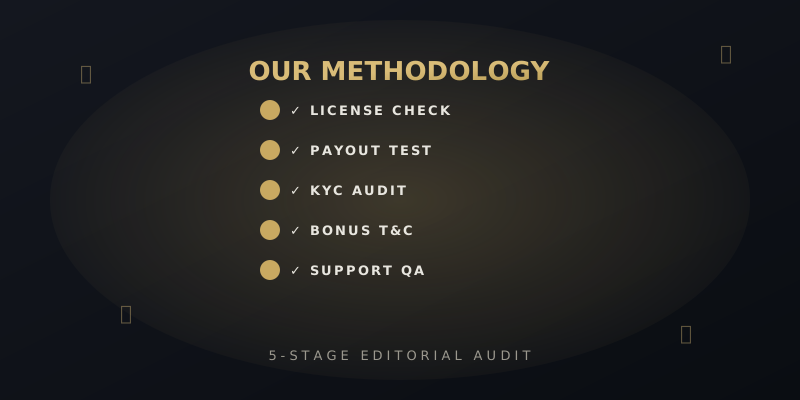
Our Methodology
Every casino in our database has gone through the same five-stage review process. Skipping a stage is grounds for removal from rankings, regardless of commission paid.
Stage 1: Account creation and verification. We register a new account with authentic personal data, complete email verification, and time the process from "register" to "deposit-ready." Casinos that require KYC at registration before any deposit get an immediate yellow flag — most legitimate offshore brands defer KYC until withdrawal.
Stage 2: Deposit testing. We make at least five deposits across different rails: USDT TRC-20, Bitcoin, a Visa or Mastercard, an e-wallet (Skrill or Neteller), and where supported, Apple Pay or Trustly. We track confirmation time, balance accuracy (some casinos silently convert to a base currency at unfavorable rates), and welcome bonus credit accuracy.
Stage 3: Active play. We play 20 to 30 sessions across slots, table games, and live casino. We record session length, average bet size, RTP behavior on representative slots, and any unusual technical issues — disconnects, lag during live games, missing game results. This phase typically generates 200 to 500 individual bets per casino.
Stage 4: Withdrawal testing. We request five to seven withdrawals across multiple methods. The amounts vary: small ($50 to $200), medium ($500 to $2,000), and at least one larger withdrawal that triggers manual review or KYC verification. We measure end-to-end time from request to settled balance and document any rejections, partial payouts, or unexpected requests.
Stage 5: T&C and complaint audit. We read the welcome bonus T&C, withdrawal terms, and general site rules in full. We cross-reference operator behavior on AskGamblers and CasinoGuru — casinos with more than three unresolved disputes for material amounts in the last 90 days are dropped from rankings even if nothing surfaced in our own review.
The result of stages 1 through 5 is a 100-point composite score across nine criteria: license trust, payment speed, support quality, bonus value, game variety, T&C fairness, complaint history, mobile experience, and editorial team confidence. The composite drives ranking position.
Licenses: Curacao vs MGA vs UKGC vs Anjouan
License jurisdiction determines what protections you actually have when something goes wrong. Below is the practical view, not the marketing version.
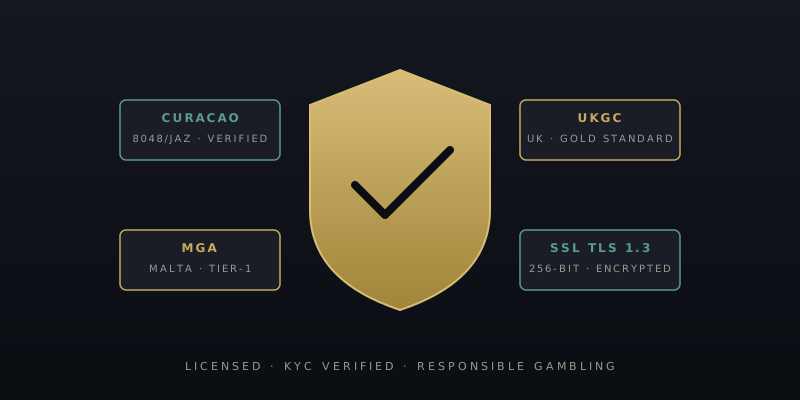
Curacao Gaming Authority (old sub-licence codes 8048/JAZ, 365/JAZ). The most common offshore licence for global-facing brands. Numbers in the XXX/JAZ format come from the pre-reform master/sub-licence scheme, which Curacao wound down with the 2023 LOK reform in favour of direct CGA licences in the OGL/2023/XXX format — so a JAZ code alone does not prove a current licence and has to be checked against the public CGA register. Operators must segregate player funds, run KYC procedures, and accept disputes through CGA. Resolution typically takes 60 to 120 days. Curacao is the minimum acceptable license — not the gold standard, but a real legal foundation. Casinos in our database holding Curacao: Stake, BC.Game, BitStarz, Roobet, 22Bet, Vulkan Vegas, N1 Casino.
Malta Gaming Authority (MGA). A strict EU regulator with mandatory player fund segregation in regulated banks, audited RTP reporting, and binding ADR for disputes. MGA is the highest practical standard for international online casinos. The trade-off is geographic reach: MGA-licensed brands typically restrict access from non-EU regions. LeoVegas and parts of the 888 group hold MGA.
UK Gambling Commission (UKGC). The strictest license in the English-speaking market. Mandatory GAMSTOP integration for self-exclusion, affordability checks for new accounts, and consumer protection law applied directly. UKGC sites are essentially UK-only and generally not relevant for global players seeking offshore options. Some UKGC brands also hold MGA for EU traffic.
Anjouan (Comoros) gaming license. A newer, cheaper offshore license popular with crypto-first brands. Dispute resolution is weaker than Curacao and the licensing process is faster. We treat Anjouan-only operators with extra caution. Several casinos hold Anjouan as a secondary license stacked with Curacao — that combination is acceptable when the operator has a multi-year track record.
For each casino in our database, we publish the full license number and link to the regulator's verification page. If a license number does not verify on the regulator's official site, the casino is removed from our database immediately.
What Distinguishes Top Casinos
After testing dozens of operators, the difference between a top-tier casino and a middle-tier casino comes down to four operational factors that are hard to fake.
Predictable withdrawal behavior. A top casino has consistent withdrawal times across the test set — 5 of 5 USDT withdrawals within a 4-to-15-minute band. A middle-tier casino has the same headline speed but with one outlier at 14 hours because "additional verification was required." Consistency is the signal.
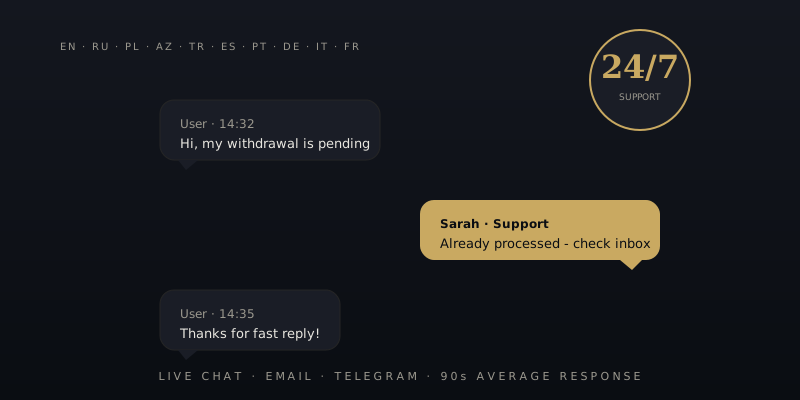
Useful support that solves problems. Live chat at a top casino reads your question, addresses the specific issue, and follows up. At a middle-tier casino, the agent sends a generic FAQ link and closes the chat. The technical content of the answer matters less than whether the agent demonstrates they actually understood the question.
T&C without weasel clauses. Top operators write T&C in normal English (or normal locale language) with specific thresholds — "maximum bet $5 during wagering," "weekly withdrawal cap $50,000." Middle-tier operators leave gaps with phrases like "irregular play patterns," "abuse of bonus," or "at the casino's sole discretion." These clauses are designed to void winnings retroactively.
Stable game library. Top casinos work with major aggregators (SoftSwiss, GAP, Slotegrator) and offer 5,000+ slots from named providers (Pragmatic Play, NetEnt, Hacksaw Gaming, Push Gaming, Nolimit City, Play'n GO). Middle-tier casinos pad libraries with white-label clones of popular slots that have manipulated RTP. Look at the provider list; brand transparency at this level is a strong proxy for operational quality.
Payment Methods — Where Withdrawals Are Fastest
Speed is not equal across casinos even on the same payment rail. The numbers below are 2026 medians from our active testing.
| Method | Fastest casinos | Median speed | Slowest typical |
|---|---|---|---|
| USDT TRC-20 | Stake (4 min), BC.Game (8 min), BitStarz (12 min) | 12 min | 90 min |
| Bitcoin | Stake (18 min), BC.Game (22 min) | 30 min | 4 hours |
| Ethereum | BitStarz (9 min), Stake (11 min) | 18 min | 2 hours |
| Lightning | BC.Game (under 1 min), Stake (under 1 min) | 30 sec | 5 min |
| Skrill / Neteller | LeoVegas (1 hour), 888 (2 hours) | 4 hours | 24 hours |
| Visa cashback | LeoVegas (1 day), Casumo (2 days) | 2 days | 5 days |
| Bank wire | LeoVegas (2 days), Bovada (3 days) | 3 days | 7 days |
Crypto withdrawals are 50 to 100 times faster than fiat at the median. If you value speed and your jurisdiction allows it, crypto is the rational default. Fiat remains the better choice if you need chargeback protection or your country blocks gambling-related card transactions.
Crypto vs Fiat: Which Path Suits You
The crypto-vs-fiat decision depends on three personal factors more than the technology.
Pick crypto if: you have an existing exchange account or wallet, your country tolerates or doesn't actively police personal crypto, you value withdrawal speed over chargeback protection, you want to avoid card-issuer block lists for gambling-related MCCs, and you are comfortable holding USDT or BTC for the duration of the deposit. Casinos like Stake, BC.Game, BitStarz, and Roobet treat crypto as the primary rail.
Pick fiat if: you need chargeback protection through Visa or Mastercard, you do not have an easy crypto on-ramp in your country, your bank tolerates gambling MCCs, or you value the regulatory framework of MGA-licensed operators that are typically fiat-focused. Casinos like LeoVegas, 888, and Casumo lead in fiat-friendly markets.
Hybrid approach: several operators — 22Bet, N1 Casino, Vulkan Vegas — accept both rails competitively. Use crypto for fast withdrawals and fiat for chargeback-protected deposits when you want both.
How We Fight Editorial Bias
Affiliate commissions create an obvious incentive to write positive reviews. We fight this with three structural rules baked into our process.
Ranking is independent of commission rate. Our 100-point composite score drives ranking position. We do not adjust scores up to favor higher-paying brands or down to penalize lower-paying ones. Several brands in our active rankings pay us 25% of revenue share; several pay 40%. The 40% brands are not ranked higher because of it.
No fixed-fee placement. We refuse "top spot" placement deals and any promotional content disguised as editorial. We have turned down five-figure offers from operators wanting guaranteed top-3 listing.
Removal threshold is the same for all. Operators are dropped from rankings when complaint volume crosses our threshold (5+ unresolved AskGamblers complaints in 90 days for material amounts) or when material T&C changes hurt players (introducing fees, restricting withdrawal speeds, adding country blocks for active markets). The threshold applies regardless of how much revenue the brand sends us.
When we delist a casino, we publish a delisting note on the review page explaining the trigger. We do not silently disappear brands when relationships sour.
FAQ
How do I choose a casino from your list?
Start by deciding crypto or fiat — it filters roughly half the database. Next, identify your priority: speed (Stake, BC.Game, BitStarz lead), bonus size (Bovada, BC.Game), beginner-friendliness (LeoVegas, 888, Casumo), or VIP value (Stake VIP, BitStarz Diamond). Read the full review of the top two candidates, paying attention to the cons section and the T&C summary. Make a small first deposit at your final pick and request a small withdrawal before scaling up.
What if I have a dispute with a casino you recommend?
First, escalate within the casino — live chat, then official complaint email, then registered support ticket. Document every interaction with screenshots and timestamps. If the casino does not resolve within 14 days, file a complaint at AskGamblers (askgamblers.com/online-casino-complaints) and CasinoGuru (casino.guru/complaints). For Curacao licensees, you can also file directly with CGA. As a last resort, contact our editorial channel via the link in our footer — we have helped resolve complaints by escalating through our affiliate manager contacts at several brands.
Are your reviews paid for?
We earn affiliate commissions when readers click through and sign up at recommended casinos. This is disclosed on every page. Critically, no operator pays us to write a review, no operator previews reviews before publication, and no operator influences star ratings or rankings. Several casinos in our database pay us less than their competitors but rank higher because of better operational quality.
How often do you update the rankings?
We re-test every casino in active rankings on a quarterly cycle — full deposit and withdrawal cycle, support test, T&C re-read. We make immediate updates when material changes occur: new license, new payment method added or removed, withdrawal speeds changing significantly, complaint volume crossing threshold. Each review page shows the date_modified field at the top so you can see when it was last verified.
Why do some casinos appear in your reviews but not in your top 10?
The top 10 is the cream of the database. Casinos in the database but not in the top 10 may be solid but have a specific limitation — restricted geography, narrow payment options, slower support — that knocks them out of the top tier without making them un-recommendable. We keep them in the database with full reviews so readers can find them when their specific need matches.
Do you cover sportsbooks, poker, and bingo?
Our primary focus is online casinos (slots, table games, live casino). Several brands in our database also operate sportsbooks (Stake, BC.Game, 22Bet, Bovada, Ignition) and we mention sportsbook quality in those reviews. We do not currently maintain dedicated sportsbook or poker rankings — those require separate testing methodology.
What to Do If Issues Arise
Even at our top-rated casinos, individual issues happen. Here is the escalation path that works.
Step 1: Internal support. Open live chat with a clear, factual description of the problem. Include account ID, transaction ID where relevant, and exact timestamps. Take a screenshot of the chat for your records. If live chat does not resolve within the same session, request escalation to a senior agent or support manager.
Step 2: Official complaint channel. If live chat fails, file a complaint via the casino's official complaint email — usually complaints@ or support@. Most operators are required by their license to have a 14-day formal response window. Mark the email as a formal complaint to trigger this clock.
Step 3: AskGamblers / CasinoGuru dispute. If the casino does not resolve in 14 days, file at askgamblers.com/online-casino-complaints or casino.guru/complaints. Both platforms have direct contacts at most major operators. Published annual reports show AskGamblers resolving 68% of accepted cases in 2025 (68% in 2024), and CasinoGuru around 28% of all filed complaints since its 2019 launch — the methodologies differ (AskGamblers counts only accepted cases, CasinoGuru counts every submission), so the numbers are not directly comparable.
Step 4: License regulator. For Curacao licensees, file at the CGA official complaint portal. For MGA, at mga.org.mt/dispute-resolution. UKGC takes complaints through resolver.co.uk. License regulator complaints take longer (60 to 120 days) but are binding on the operator.
Step 5: Casino Decoded editorial channel. If you used our review to find the casino and steps 1 through 4 have failed, contact our editorial channel — link in every page footer. We cannot guarantee resolution, but we have direct relationships with affiliate managers at every brand we recommend, and an internal escalation often unsticks a stuck case. We also use these reports to update our rankings when patterns emerge, so even unresolved complaints help future readers.
Complete Audit Checklist: 32 Points of Our Methodology
Below is the full checklist by which Casino Decoded evaluates every operator before publishing a review. If you're independently assessing an unfamiliar casino, work through these points for an objective picture.
License and Legal Foundation (points 1–5):
- Regulator and license number stated in the footer. The number must verify on the regulator's official site (cga.cw for Curacao, mga.org.mt for MGA, gamblingcommission.gov.uk for UKGC). Number doesn't verify = fake license.
- Legal entity (operating company) stated. Format like "Casino XYZ is operated by Direx N.V., registered in Curacao under number 145178."
- License issue date. License younger than 6 months = new operator, requires extra caution.
- Operator history. Year founded, brand history, mentions in industry news. Operators less than 1 year old = elevated risk.
- Ownership transparency. Serious holdings disclose: parent company, affiliated brands, management contact details.
Payments and Financial Infrastructure (points 6–11):
- Minimum 5 different payment methods with specific processing times stated (not "fast" but "5–60 minutes").
- Cryptocurrency support. Without crypto rails, the operator is technologically outdated for the global market.
- USDT TRC-20 specifically supported. The dominant offshore stablecoin rail.
- Clearly stated minimums and maximums for each method. Transparency = sign of a reliable operator.
- Stated payout times — concrete numbers, not "as soon as possible."
- No hidden fees. Good operators show full fee information in the cashier before transaction confirmation.
Bonuses and Conditions (points 12–16):
- Welcome bonus size reasonable (50–300%). 500%+ promises are usually offset by draconian wagering.
- Wagering on welcome bonus no higher than 40x. 50x+ = bonus practically impossible to clear.
- Maximum bet during wagering stated specifically ($5–$10). "Don't exceed reasonable" = arbitrary void clause.
- Bonus validity at least 14 days. Weak operators give 24–72 hours, unrealistic for clearing.
- Games with 100% wagering contribution comprise the majority of slots. If only 30–50% of slots count for wagering, that's hidden complication.
Game Library (points 17–21):
- Minimum 5,000 slots. Less = incomplete portfolio.
- Minimum 6 top providers: Pragmatic Play, NetEnt, Play'n GO, Hacksaw Gaming, Quickspin, Yggdrasil. Without at least 4 of these 6 = impoverished portfolio.
- Live Casino from Evolution Gaming or Pragmatic Play Live. Without at least one = mediocre live segment.
- Crash games (Aviator or alternatives). Now must-have for player engagement globally.
- Ability to filter slots by RTP, volatility, provider, and features. Weak operators have primitive filtering.
Support and Service (points 22–25):
- 24/7 chat in English (and your language if applicable) with response time under 5 minutes. Weak ones offer email-only with 24-hour delays.
- Real human agents, not machine translation from another language. Test with a clarifying question.
- Escalation to manager or security team available. If first line can't resolve, there must be a path forward.
- Knowledge base with FAQ — comprehensive and updated. Good operators invest in self-service.
Responsible Gambling (points 26–28):
- Deposit, bet, and loss limits — configurable from account settings in 2 clicks.
- Self-exclusion from 24 hours to indefinite. With reputable operators this is a button, not an email request.
- Information on signs of gambling addiction and contact details for help (gamcare.org.uk, ncpgambling.org, etc.).
Reputation and Trust (points 29–32):
- AskGamblers rating — 7.5+/10. Below = systemic problems.
- CasinoGuru Safety Index — 7+/10. Considers complete complaint history.
- 90-day complaints — no more than 3 unresolved on material amounts. More = systemic problem.
- Domain age — minimum 6 months for new operators, 2+ years for mature ones. Fresh domains without history = elevated risk.
If an operator passes 26 of 32 points, they're a reliable candidate for top-10. 20–25 = playable with caution. Less than 20 = skip.
Top Scam Schemes 2026: How to Detect Fraud
The industry doesn't stand still, and fraudulent schemes evolve too. Based on CasinoGuru complaint analytics for 2025 and our own monitoring, the following schemes dominate in the current year.
Scheme 1: "KYC stalling." The most common. Player wins a meaningful amount, requests withdrawal. Casino requests KYC. Player submits documents. Casino rejects them with various reasons: "poor photo quality," "wrong format," "additional document required — proof of income." Cycle can repeat 5–10 times, stretching 2–3 months. Some players give up, and the casino keeps the winnings. Defense: send quality photos from the start; on first rejection, immediately escalate to manager; on repeated rejections, file a CasinoGuru complaint with chat history attached.
Scheme 2: "Retroactive T&C changes." Player completes wagering, requests withdrawal. Casino responds: "sorry, we recently updated rules, your welcome bonus now has a $500 cashout cap, not $5,000." Defense: save screenshots of T&C at registration and bonus activation. In disputes, these screenshots are your primary argument.
Scheme 3: "Invisible max bet." Rules state: "max bet during wagering $5," but during play there are no system blocks — you can bet $50. After completion attempt: "you violated T&C, bonus and winnings voided." Defense: always read T&C before play, write down key limits, don't rely on casino "technical blocks."
Scheme 4: "Phantom promo code deposit." Player gets promo code from streamer/blogger for "exclusive 200% deposit bonus." Makes large deposit, activates code. Bonus doesn't credit. Support responds: "code expired/invalid." Defense: verify codes through multiple sources; don't make large deposits at unknown operators based on promo codes.
Scheme 5: "Cloned domains." When official domain is blocked (or the player is misled by SEO), Telegram channels and search results show "fresh mirrors" — phishing sites that steal login credentials. Defense: use mirrors only from official sources (support, verified Telegram channel of the operator). Never enter credentials on a site you haven't verified.
Scheme 6: "Multi-account accusation." Casino accuses player of creating multiple accounts ("system detected login from same IP as another account") and blocks winnings. Often legitimate household scenario — husband and wife playing from same Wi-Fi. Defense: at registration, declare other potential players in household if applicable; save documents showing separate identities.
Scheme 7: "Withdrawal tax." Especially popular in newer offshore operators. On withdrawal request, casino demands "10–20% tax payment up front," promising refund after withdrawal. Money is accepted, payout never happens. Defense: no licensed casino demands prepayment of tax. This is 100% fraudulent.
Scheme 8: "Expedited withdrawal for additional fee." "Standard withdrawal 7 days, expedited for $50 — instant." Fraudulent operators exploit player impatience. Defense: don't pay for "expedites." Serious casinos have loyalty programs with fast withdrawals for VIPs, but these come from activity, not prepayment.
Scheme 9: "Reverse withdrawal via inattention." Not strictly fraudulent but manipulative. Player requests withdrawal. Funds "hang" 24–48 hours in "Pending." Player sees balance and psychologically perceives it as "still available for play." In emotional moments hits "Cancel withdrawal" and gambles back. Defense: after withdrawal request, physically close the casino, don't return until funds arrive.
Scheme 10: "Bonus trap with undisclosed restrictions." Welcome bonus auto-activates on deposit, and conditions state: "bonus cannot be canceled manually." Player didn't want the bonus but is now obligated to clear it before withdrawing any deposit. Defense: always check whether bonus auto-activates; ask support pre-deposit if uncertain.
KYC Walkthrough: Step-by-Step Instructions
KYC is where many players stumble. Let's walk through the process step by step, with document types and pitfalls.
Stage 1. Document preparation. What you'll need:
- Government ID. Passport, national ID card, or driver's license. Most casinos prefer passport. Take quality photos of the photo page and personal data — no glare, all corners visible, text readable. Don't cover any data.
- Selfie with ID. Hold the ID open near your face. Face and ID page must be clearly visible. No filters, no sunglasses (unless on the ID photo). Good lighting.
- Proof of address. Not always requested but often. Acceptable: bank statement with address from last 3 months, utility bill (electricity, gas, internet), rental agreement. Document must be PDF or JPG, readable text, visible date.
- Proof of source of funds (for large amounts). Requested at withdrawals from $5,000–$10,000. Acceptable: payslip, bank statement showing salary deposits over 3–6 months, employment contract, tax return for self-employed.
Stage 2. Document upload. In account settings find "Verification" or "KYC" section. Upload documents one by one, checking quality of each. Don't upload screen captures — direct photos or scans needed. File size usually limited to 5–10 MB per document.
Stage 3. Waiting. Standard time — 4 hours to 3 business days. Top-tier operators usually fit within 24 hours. Concurrently you may receive an email confirmation link or SMS code to confirm phone — handle promptly.
Stage 4. Possible additional requests. Sometimes the security team asks for: "stamped bank statement," "new selfie," "photo of your phone in front of mirror with casino app open" (a real anti-fraud request from some operators). If requests look reasonable — fulfill them. If you're uncertain — ask support for justification.
Stage 5. KYC confirmation. After successful completion you receive a "Verification complete" email. In your account in the Verification section status changes to "Verified" or "Approved." Now you can request withdrawals without delays.
Pitfalls:
- Mismatched data at registration vs ID. If you registered as "Alex" but ID says "Alexander" — rejection. Register exactly as on ID.
- Using someone else's documents. Strictly prohibited. AML violation, casino can lifetime-ban the account with balance forfeit. If a relative plays for you — they must register on their own documents.
- Expired ID. Loading expired document = automatic rejection. Renew before starting play.
- Hiding sovereign identity. Players sometimes try to bypass geo-filters and register from another country (using VPN, fabricating address). At KYC this surfaces, and account gets blocked.
How many times to do KYC. Once per casino. After completion at one operator, you don't redo at withdrawal in same casino (though larger amounts may trigger additional checks). But at new casino registration — KYC redone, no shared system.
Rating Explained: What Each Score from 1 to 10 Means
Our 10-point scale may seem subjective. In reality it's mathematically derived from criteria weights. Score interpretations:
9.0–10.0 — Industry benchmark. Operator without significant weaknesses. Withdrawal speeds on top methods (USDT, BTC) within 30-minute median. KYC in 4–24 hours. Support responds in 1–3 minutes in English. AskGamblers rating 8.5+. Last 90 days — fewer than 2 unresolved complaints. In our rankings, 1–2 operators at this level at any given time.
8.5–8.9 — Very strong operator. One or two points may be weaker than benchmark (e.g., average crypto speed 30–60 minutes, or KYC up to 2 days), but overall reliable choice. Recommended for everyone without specific requirements. We typically have 3–5 operators at this level.
8.0–8.4 — Good operator with trade-offs. Systematically functional, but with several noticeable weaknesses. For example: strong product but wagering on welcome higher than typical (50x), or average withdrawal speed (90–180 minutes median). Suitable for players who understand trade-offs and choose by priority.
7.5–7.9 — Average operator. Functional but without outstanding qualities. Withdrawal speeds 3–6 hours, KYC 2–3 days, support with 5–10 minute delay. Usable as "secondary" operator, not primary. This range rarely reaches our top-10 but appears in extended database.
7.0–7.4 — Weak operator with known issues. Several systemic problems: payout delays beyond promises, complex KYC, template support. Playable on minimal amounts for testing, not for serious play. Usually outside our top-10.
6.5–6.9 — Problematic operator. Many complaints in last 90 days, regular payout delays, low rating on external platforms. Don't recommend without specific reasons.
Below 6.5 — Not recommended. Operator has serious systemic problems making play high-risk. Usually we don't publish these — no point. If an operator drops below 6.5 sharply, we mark the review "not recommended" and leave it for information, without affiliate link.
Important nuance: scoring isn't static. After each quarterly review, positions adjust.
License History: How the Regulatory Landscape Changed
Curacao: from pyramid to direct license. Until 2023, Curacao used a pyramid scheme: Gaming Control Board issued licenses to 4 master licensees (Curacao eGaming, Antillephone, Cyberluck, Gaming Curacao), who in turn issued sub-licenses to hundreds of operators. Sub-licensees worked under formats like 8048/JAZ (from Antillephone) or 365/JAZ (from Curacao eGaming). Regulatory oversight was soft, complaints handled slowly.
In 2023, Curacao conducted a major reform: master licenses were abolished, each casino now receives a direct license from the Curacao Gaming Authority (CGA), which succeeded the Gaming Control Board, with direct accountability. New format numbers: OGL/2023/XXX/X. The reform improved transparency: now it's clear who's responsible to the regulator, simplified complaint filing. By 2026, most old-format licenses are either converted to direct or the operator closed.
What this means for the player. If a casino has new format (OGL/2023/XXX), regulation is stricter, complaints more effective. Old format 8048/JAZ or 365/JAZ — operator works on pre-reform license, not critical but indirectly indicates license age.
MGA: strict regulator evolution. Malta Gaming Authority systematically tightened requirements 2018–2024. Mandatory ADR mechanism for player-operator disputes. Limits on aggressive marketing (some phrases banned). Mandatory responsible gambling tools. Minimum operator financial reserve raised to €500,000.
UKGC: era of strict regulation. UK Gambling Commission since 2019 became strictest online gambling regulator. Credit card ban for deposits (debit only), mandatory GAMSTOP (self-exclusion system), wagering cap at 40x, mandatory regular income-vs-deposits matching (anti-money laundering).
Anjouan (Comoros): new player on the market. In 2023 Anjouan started issuing gambling licenses as Curacao alternative. License cheaper ($35,000 vs $50,000 at Curacao), faster process (3 months vs 6 months), looser requirements. By end of 2025 about 80 operators were Anjouan-licensed, mostly new ones. For the player — "entry-level license": formal registration but minimal real regulatory oversight.
Editorial Calendar: How We Plan Review Updates
Monthly tests for top-10. Each operator from our top-10 goes through payout test monthly: 2–3 transactions on main methods. Goal — track stability of metrics over time. Sharp jump from 47 minutes to 4 hours = signal for deep investigation.
Quarterly full tests. Once a quarter (January, April, July, October) each top-10 operator goes through full cycle: 12+ transactions across methods, KYC test from document submission to approval, support test with 5–7 typical questions, T&C re-reading, bonus rule change checks. Quarterly test results — adjustments to ranking positions.
Semi-annual review for ranks 11–30. Operators at ranks 11–30 are reviewed every 6 months (January and July). Less frequent but deeper: checking if they grew (then we raise position), if problems emerged (lower or remove).
Reactive updates on complaints. If 5+ complaints appear on CasinoGuru/AskGamblers about an operator from our rankings within a week — we open reactive investigation within 48 hours. Request operator's official position, check our readers for similar cases, redo test cycle. Outcomes possible: position lowered (1–2 points), recommendation temporarily removed, or full removal from rankings.
Monthly context updates. Beyond metrics, we track regulatory environment changes (new domain blocks, regulation changes, news from various jurisdictions), new payment methods (new network launches, USDT fee changes), general industry trends. These data integrate into hub pages.
Annual pivot review. Once a year (December–January) we do a full methodology review: are criteria weights distributed correctly, are there blind spots in the checklist, is it time to add new metrics. This is deep work for 2–3 weeks; methodology pages get updated as a result.
For readers, what matters is the date_modified on a specific page — it's at the top. If older than 90 days — data may be stale, verify with operator support. If updated in last 30 days — data is maximally fresh.